

Pore systems in oil-window mudrocks of the lower Green River Formation (Castle Peak Shale through Lower Garden Gulch), Uinta Basin, Utah
Maxwell Pommer (Presenter) 1, 2 , Luke Fidler 3
Stratascope Geologic 1 , University of Colorado Boulder 2 , SM Energy 3
Abstract:
Stratigraphic, petrographic, geochemical, and petrophysical data from a core in the Central Basin region of the Uinta Basin indicate abundant hydrocarbon-saturated reservoir porosity in lower Green River Formation organic-matter(OM)-rich and OM-bearing mudrocks. Pore-systems in these rocks are interpreted to have evolved with variable detrital and near-surface diagenetic components and fabrics overprinted by differential burial diagenesis into the oil window (mean Ro=0.97).

The core spans ~1,100ft of section from the Castle Peak Shale to the Lower Garden Gulch. It is comprised predominantly of cyclically interbedded: 1) sandstones and sandy conglomerates, 2) OM-lean siliciclastic mudrocks, 3) OM-bearing and OM-rich siliciclastic mudrocks and argillaceous conglomerates, and 4) OM-bearing and OM-rich carbonate mudrocks and intraclast rudstones-floatstones. Substantial pore volumes occur in sandstones and sandy conglomerates (mean=8.8%), as well as OM-lean siliciclastic mudrocks (mean=9.9%), predominantly comprised of clay-hosted and interparticle micro/nanopores, however these tend to be water-saturated (mean=63.5 and 75.3% respectively). OM-rich and OM-bearing siliciclastic mudrocks and argillaceous conglomerates contain variable amounts of interparticle & clay-hosted micro/nanopores, as well as OM-hosted nanopores. Measured pore volumes range from 5.2% to 13.6% (mean=10.1%), and hydrocarbon saturations range from 3.2% to 84.2% (mean=43.2%). OM-rich and OM-bearing carbonate mudrocks and intraclast rudstones-floatstones host variable amounts of interparticle and intercrystalline micro/nanopores as well as OM-hosted nanopores. Measured pore volumes range from 3.4% to 15.0% (mean=8.2%), and hydrocarbon saturations range from 19.3% to 94.1% (mean=63.8%). Pore volumes are, on average, higher in OM-rich and OM-bearing siliciclastic mudrocks than carbonate mudrocks, however hydrocarbon saturations and volumes of hydrocarbon-saturated porosity are higher in carbonate mudrocks (mean BVHC=4.4% for siliciclastic mudrocks and 5.2% carbonate mudrocks).
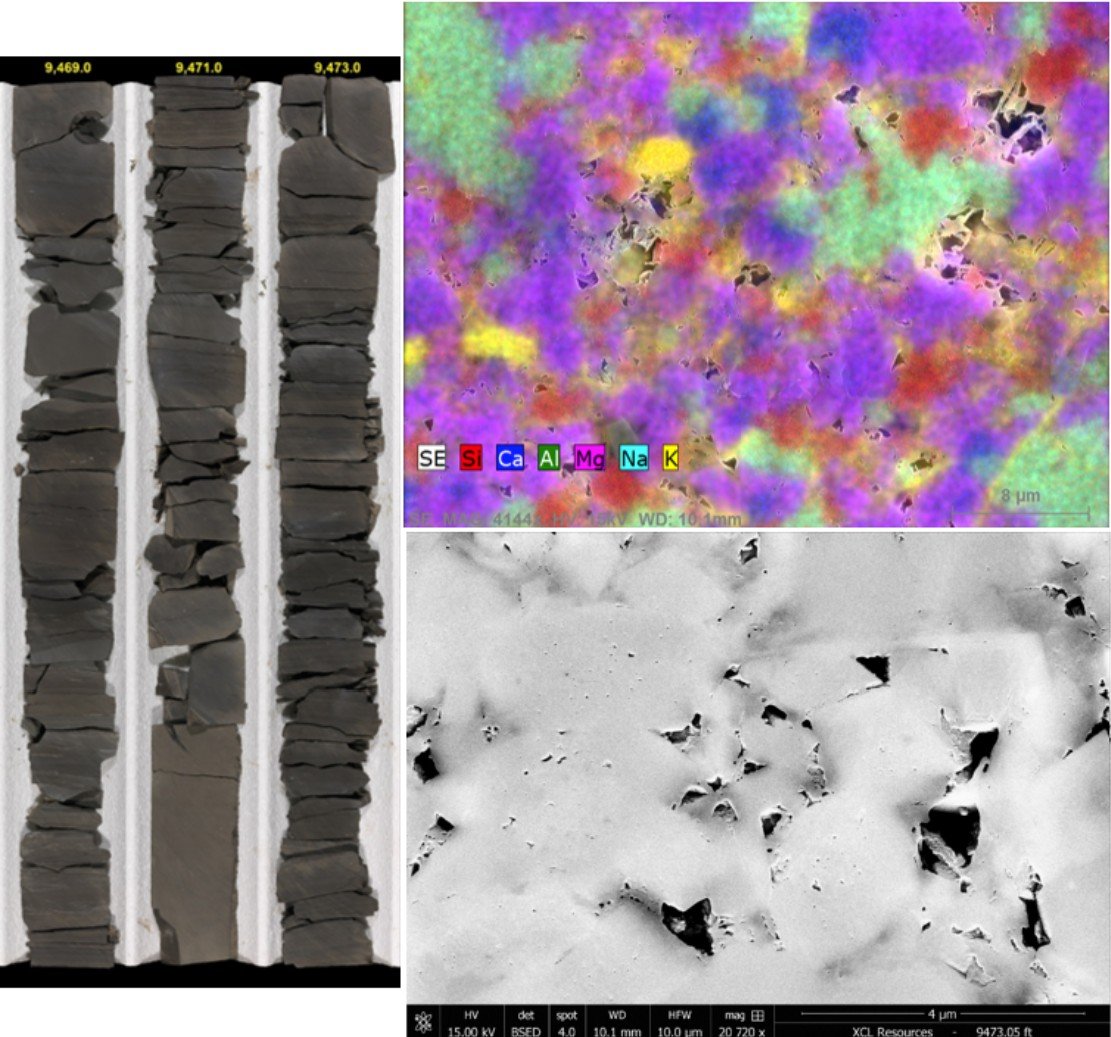
In OM-rich and OM-bearing mudrocks, near-surface mineralization, compaction and thermal maturation of organic matter had variable impacts on pore systems. Crystals of dolomite, Fe-carbonate, calcite, feldspars, and sulfides are commonly widespread in carbonate mudrocks and scattered throughout siliciclastic mudrocks, many of which are interpreted as pore-filling cements. Compaction strongly impacted mudrocks, especially ductile components like detrital clay and kerogen which are commonly deformed. It is unclear how much mechanical compaction impacted pore space in carbonate mudrocks. Clear examples of secondary OM (aka bitumen) filling former pore space do occur; however amorphous OM of ambiguous origin is very common. OM-hosted porosity occurs in both detrital and secondary OM and is often patchy and poorly developed. OM-hosted porosity tends to be well-developed between rigid grains and crystals (especially dolomite crystals) where it was sheltered from the impacts of compaction. Higher hydrocarbon saturations and abundance of surface-coating hydrocarbons on dolomite surfaces observed in SEM images suggest an affinity of hydrocarbons for dolomite surfaces and more oil-wet surface chemistry in carbonate mudrocks.
Bio:
Max is a geologist specializing in integrated reservoir characterization using stratigraphic, petrographic, geochemical, and petrophysical methods. His research focuses on pore-system evolution in subsurface reservoirs, linking diagenesis and sequence stratigraphy, the origin of dolomite, as well as paleoenvironmental and biogeochemical dynamics.
Currently, he is a Geologic Consultant at Stratascope Geologic and a Faculty Lecturer at the University of Colorado Boulder, where he teaches Subsurface Reservoir Geology and Field Sedimentology and Stratigraphy. His consulting work integrates core description, petrography, and subsurface data to support hydrocarbon, carbon sequestration, and water disposal projects across North America and the Middle East.
Max holds a bachelor’s degree from the University of Colorado Boulder, a master’s degree from The University of Texas at Austin, and a doctorate from Colorado School of Mines. Previously he was a Postdoctoral Researcher at Colorado School of Mines as well as Senior Geological Advisor and Lead Sedimentologist at Premier Corex. He has worked in applied sedimentology and reservoir characterization since 2011.
Registration is closed
This is an in-person and online event!
The cost is $30.00 for current members and $40.00 for non-members. Zoom registration is $10.00 ($5.00 for students). Unemployed individuals may sign up for lunch for just $20.00. Students may sign up for lunch for $20.00. Persons who do not wish to have lunch are welcome for a $20.00 fee. Walk-ins may purchase a lunch for the standard fees ($30.00 or $40.00) although quantities are limited. Walk-ins without a lunch are charged a $15.00 fee.
Please submit reservations by 10:00 a.m. the Friday before the talk.
Reservations may be secured online or by e-mail at information@rmssepm.org